

Deel Ecosystem - Spain Hiring Guide - El Ecosistema x Deel - 8-10 min read
Spain has become one of the most attractive European markets for international companies looking to hire experienced, multilingual and increasingly remote-ready talent. The country combines a large pool of software engineers, sales professionals, operations specialists, customer success teams, finance profiles and creative talent with a strategic position inside the European Union. It also gives companies access to a working culture that often connects naturally with both Europe and Latin America.
But hiring in Spain is not the same as hiring in a generic European market. Employment relationships are shaped by Spanish labor law, social security rules, payroll reporting, collective bargaining agreements and strict expectations around employee classification. A company that wants to hire in Spain in 2026 needs to understand the local employment framework before signing a contract, paying a worker or building a remote team.
This guide is designed for international companies that want to hire Spanish talent, employ remote workers in Spain or test the Spanish market without immediately opening a local subsidiary. It covers the main hiring models, employment contracts, payroll and tax requirements, compliance risks, benefits and the choice between opening a Spanish entity or using an Employer of Record such as Deel.
Why companies hire in Spain
Spain offers a strong combination of talent quality, market access and cost efficiency. Many international companies look at Spain because they can hire skilled professionals at compensation levels that are often competitive compared with markets such as the United Kingdom, Germany, the Netherlands or the United States. This does not mean Spain is a low-cost market. It means the value-to-cost ratio can be compelling when companies need senior talent, European coverage and long-term team stability.
The country also sits in a practical time zone for distributed companies. Spanish teams can collaborate with the rest of Europe during the full working day, overlap with the United Kingdom, connect with parts of the Middle East and Africa, and still maintain several hours of overlap with teams in North America. For companies serving Spanish-speaking customers, Spain can also become a bridge between European operations and Latin American markets.
Remote work has made Spain even more relevant. Cities such as Madrid, Barcelona, Valencia, Malaga, Bilbao, Zaragoza and Seville have become attractive bases for professionals who want access to strong infrastructure, international communities and a high quality of life. For employers, this creates an opportunity to hire people where they already live, instead of asking them to relocate to a headquarters city.
However, the opportunity comes with a clear requirement: companies must respect Spanish employment rules. Hiring someone who works from Spain may trigger local obligations even if the company is headquartered elsewhere. Payroll, social security contributions, working time, contract type, termination rules and benefits cannot be handled as an afterthought.
Main ways to hire in Spain
International companies usually consider three routes when hiring in Spain: opening a local entity, hiring contractors or using an Employer of Record.
Opening a local entity gives a company direct control. It can employ workers under its own Spanish company, run local payroll, register with the relevant authorities and manage employment relationships internally. This route can make sense for companies planning a long-term, sizeable presence in Spain, especially if they expect to hire many employees, sign local commercial contracts, rent offices or build a local management structure. The trade-off is time, cost and administrative complexity.
Hiring contractors or freelancers can be faster, but it carries classification risk. Spain has clear differences between self-employed professionals and employees. If a person works under the direction of the company, depends economically on one client, follows fixed schedules, uses company tools and behaves like part of the internal team, the relationship may be challenged as employment. Misclassification can lead to tax, social security, penalties and retroactive employment obligations.
Using an Employer of Record like Deel can be useful when a company wants to hire employees in Spain without setting up a Spanish entity. In an EOR model, the EOR becomes the local legal employer while the worker performs day-to-day services for the client company. This can help companies onboard Spanish employees, process payroll, manage local employment contracts, handle social security contributions and stay aligned with local compliance requirements.

Employment contracts in Spain
Employment contracts in Spain are not just administrative documents. They define the employment relationship and must reflect local law, the role, the salary, working conditions and the applicable legal framework. International companies should avoid copying a contract template from another jurisdiction and translating it into Spanish. Localized employment contracts matter.
Indefinite employment contracts are the standard model in Spain. They are designed for ongoing employment relationships and are generally the safest route when a company expects the role to continue beyond a short, clearly justified period. Spanish reforms have limited the use of temporary employment, so temporary contracts must fit specific legal grounds. Using a temporary contract where an indefinite contract is required can create legal exposure.
Probation periods may be allowed, but they depend on the role, contract type and applicable collective bargaining agreement. A company should not assume that a six-month probation period is always valid. Collective bargaining agreements can also influence salary bands, working time, job categories, paid leave and other employment conditions. In Spain, the applicable collective agreement can be just as important as the individual contract.
This is where Deel's localized employment contracts and country-specific onboarding can be valuable. Companies hiring in Spain need contracts that reflect Spanish requirements, not generic international templates. A localized onboarding flow can also help collect the right information before the employee starts work, including personal data, tax details, social security information and employment documentation.
Payroll, taxes and social security
Payroll in Spain involves more than sending a monthly salary payment. Employers need to process gross salary, employee tax withholding, employer social security contributions, employee social security contributions, payslips and reporting obligations. Payroll must be calculated and documented correctly, and employees should receive proper payslips that reflect salary, deductions, contributions and net pay.
Foreign employers often underestimate the importance of social security registration and contributions. Spanish employees are generally covered by the Spanish social security system, and employers have obligations to register employment, calculate contributions and submit payments. These obligations can vary depending on salary, contract type and applicable rules, so companies should treat payroll as a compliance function, not only a finance process.
Employee income tax withholding is another key requirement. Employers must withhold and report taxes according to Spanish rules. Incorrect withholding can create issues for both the employee and the company. For international teams, this is especially important because compensation structures, equity, bonuses, allowances and benefits may need local review before they are included in a Spanish employment package.
Deel supports payroll processing, social security contributions and local compliance support for companies hiring in Spain through an EOR model. That can reduce the operational burden for companies that do not yet have a Spanish payroll team or local entity. It can also give finance and people teams a clearer process for onboarding, paying and managing Spanish employees.

Working time, holidays and employee benefits
Spanish employment rules include obligations around working time, holidays, leave and benefits. Companies should understand these obligations before setting expectations with a new hire. A remote employee in Spain is not automatically governed by the same holiday calendar, sick leave rules or working time policies as employees in another country.
Working hours are subject to Spanish law and, in many cases, collective bargaining agreements. Companies may need to track working time, define schedules, respect rest periods and account for overtime. Remote work policies should also be adapted to Spain, especially when employees work from home on a regular basis.
Paid holidays are a core part of employment in Spain. Employees are entitled to annual paid leave, and public holidays may apply depending on national, regional and local calendars. Sick leave, parental leave and other statutory leaves must also be handled according to local rules. In practice, this means HR teams need local processes, not only global policy documents.
Benefits may also be influenced by collective agreements and market expectations. Some roles or sectors may have additional obligations or common benefits. International companies should check whether the applicable collective agreement affects salary, working hours, allowances, professional category, remote work provisions or other employment conditions.
Compliance risks when hiring in Spain
The first major risk is worker misclassification. Treating a Spanish worker as a contractor when the relationship looks like employment can create legal and financial exposure. This is especially relevant for companies that hire remote workers quickly and use contractor agreements as a default. If the worker is integrated into the team, follows company direction and works mainly for one company, the arrangement deserves careful review.
The second risk is using the wrong contract type. Temporary contracts require a valid reason. Probation periods must be appropriate. Collective agreements may apply. A contract that seems simple from a global HR perspective can be incomplete from a Spanish labor law perspective.
The third risk is missing payroll obligations. Payroll processing, tax withholding, social security contributions and payslips must be handled correctly. Delays or errors can affect the employee and create compliance issues for the company.
The fourth risk is ignoring collective bargaining agreements. Spain has a strong collective agreement framework, and the applicable agreement can influence employment conditions. Companies entering Spain for the first time often focus on statutory rules but miss sector-level obligations.
Termination risk is also important. Ending employment in Spain requires process, documentation and local analysis. Notice, severance and justification may depend on the circumstances. Companies should not assume that at-will employment concepts from other markets apply in Spain.
Finally, setting up operations without local compliance knowledge can create unexpected obligations. Hiring several people in Spain, directing their work locally or building a long-term presence may raise questions about entity setup, tax presence and employment compliance. Companies should get advice before scaling.
Entity vs EOR in Spain
| Option | Best for | Main advantages | Main challenges |
|---|---|---|---|
| Local entity | Companies planning a long-term Spanish operation with multiple hires, local management or commercial activity. | Direct control, local presence, ability to build a full Spanish operation. | Setup time, legal administration, payroll registration, ongoing accounting, tax and HR compliance. |
| Contractors | Project-based work with independent professionals who control how they deliver services. | Fast to start, flexible, useful for limited scopes. | Misclassification risk, limited control, not suitable for employee-like roles. |
| Employer of Record | Companies hiring Spanish employees before opening an entity or testing the market. | Hire without opening a Spanish entity, localized contracts, onboarding, payroll, social security contributions and compliance support. | The EOR is the local legal employer, so companies should align internal processes with the EOR model. |
The right route depends on strategy. A company hiring one remote employee in Spain may not want to open an entity immediately. A company building a 50-person Spanish office may eventually need one. A company testing the market may prefer an EOR first, then decide whether to create a subsidiary later.
How Deel helps companies hire in Spain
Deel enables companies to hire employees in Spain without setting up a Spanish entity. For international companies, this can be useful when they want to move quickly, hire a candidate who already lives in Spain, support remote-first expansion or validate the Spanish market before making a larger legal commitment.
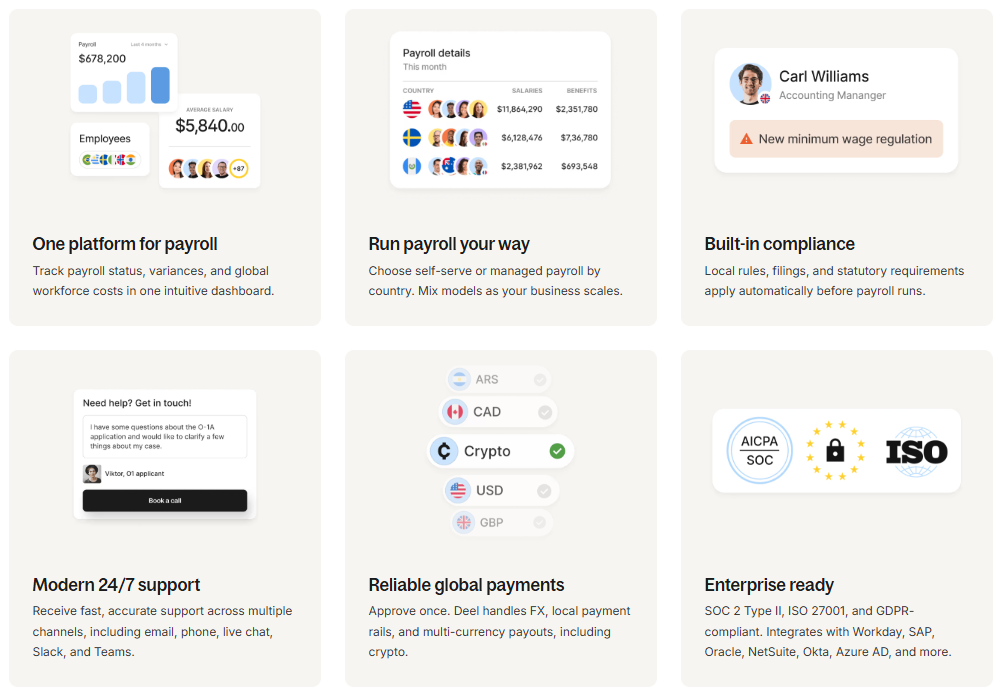
Through its EOR capabilities, Deel can support localized employment contracts, country-specific onboarding, payroll processing, social security contributions and local compliance support. These are not small details. They are the operational foundation of compliant employment in Spain.
Deel can also help companies create a more consistent global hiring process. Instead of building a new vendor stack for every country, teams can manage onboarding, documents, payroll and employment workflows through a platform built for international teams. For companies hiring across Europe, this can reduce fragmentation and help HR, finance and legal teams stay aligned.
For Spain specifically, Deel may be useful when hiring remote employees, expanding a European team, building Spanish-language customer operations, recruiting technical talent or testing whether Spain should become a larger market for the company. The key is to use an EOR for the right use case: compliant employment without immediately opening a Spanish entity.
Spain hiring checklist
- Choose the right hiring model.
- Understand the applicable contract type.
- Check collective agreement obligations.
- Register and process payroll correctly.
- Manage social security contributions.
- Set up compliant onboarding.
- Decide whether to open an entity or use an EOR.
FAQ
Can a foreign company hire employees in Spain?
Yes, but the company needs a compliant way to employ the worker. That usually means opening a Spanish entity or using an Employer of Record. Hiring someone informally, paying them from abroad without local payroll or treating an employee-like role as freelance can create compliance issues.
Do you need a local entity to hire in Spain?
Not always. A local entity is one option, especially for companies building a long-term Spanish operation. An Employer of Record can allow a company to hire employees in Spain without opening a Spanish entity, while still supporting local contracts, payroll and compliance.
What is an Employer of Record in Spain?
An Employer of Record is a local legal employer that hires the employee in Spain on behalf of a client company. The employee works day to day with the client company, while the EOR manages employment administration such as contract setup, payroll, social security contributions and local compliance.
Is it better to hire contractors or employees in Spain?
It depends on the relationship. Contractors can be suitable for independent project-based work. Employees are more appropriate when the person works under company direction, is integrated into the team and performs ongoing work. Misclassification is a key risk, so companies should review the facts before choosing a contractor model.
How can Deel help companies hire in Spain?
Deel can help companies hire Spanish employees through EOR, localized contracts, onboarding, payroll processing, social security contributions and local compliance support. This can be especially useful for companies that want to hire in Spain before opening a local entity.
Hire employees in Spain without opening a local entity
If your company wants to hire Spanish talent without setting up a Spanish entity, Deel can help you onboard, pay and manage employees in Spain compliantly.
This guide is for informational purposes only and does not constitute legal, tax or labor advice. Employment rules can change and every hiring scenario is different. Companies should consult qualified specialists before making specific employment decisions in Spain.